Wiggins Board of Aldermen: July 14 | Water & Sewer Rates
No formal action on rates was taken at this meeting. It was called for discussion only. The board is expected to take up a rate proposal at its regular meeting Tuesday, July 21, 2026, at 5:00 p.m.
I. Call to Order
The special called meeting was called to order at 5:30 p.m. The stated purpose: to present the findings of the city’s water and sewer rate study and hear from residents before the board considers a rate increase.
II. Invocation
An invocation was offered.
III. Pledge of Allegiance
The Pledge of Allegiance was recited.
IV. New Business — Water & Sewer Rate Discussion
The rate study
Engineer Ryan Tice, who prepared the rate study from the city’s budget records, presented the numbers.
Under current rates, a residential customer pays a base of $13.00 for the first 3,000 gallons of water and $20.00 for the first 3,000 gallons of sewer, with volumetric charges of $3.75 and $4.50 per 1,000 gallons above that. Commercial customers pay $20.00/$2.95 for water and $25.00/$4.75 for sewer. Rates have not been raised in roughly ten years; the last rate review, in 2019, ended when the Enviva project it was tied to fell through.
Averaged over the past two years, the water and sewer system generated $1.04 million in revenue against $1.73 million in expenses — a shortfall of roughly $700,000 per year. Current rates cover about 60 percent of the cost of running the system.
Tice presented three adjustment scenarios from the study:
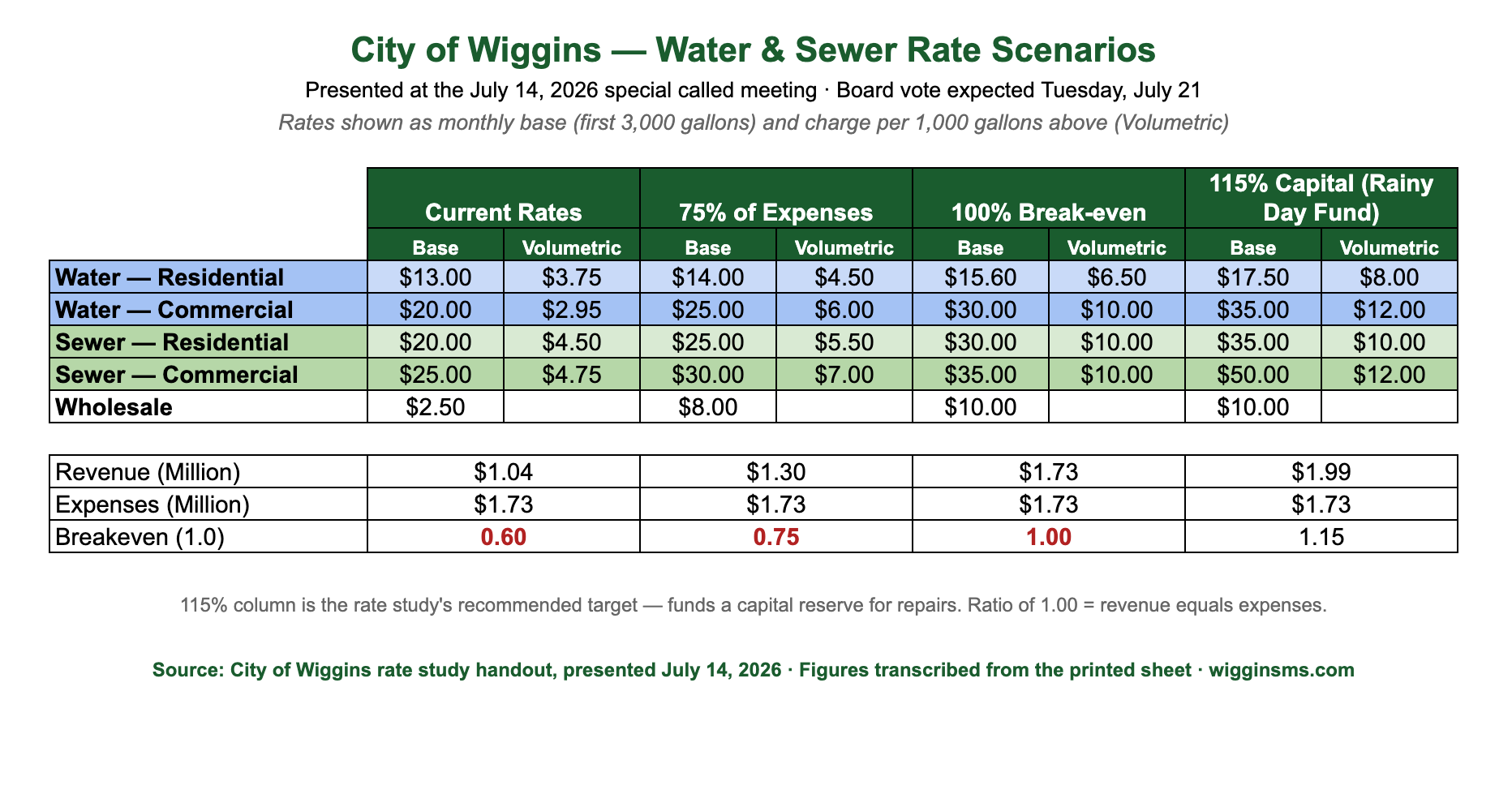
The 115 percent level, the recommended target, would fund a capital reserve for repairs and replacements. State statute directs a rate increase once a system’s revenue-to-expense ratio falls to 1.10; Wiggins sits at 0.60. Water and sewer operate as an enterprise fund, which by state law must pay for itself; the city cannot cover it from, or transfer it to, the general fund.
In dollar terms: a 100 percent increase adds about $12.60 per month to the residential base (water and sewer combined, at 3,000 gallons). A customer now paying the $51 minimum monthly bill — water, sewer, and garbage — would pay about $63.60 under the 100 percent scenario.
A 115 percent increase adds about $19.50 per month to the residential base (water and sewer combined, at 3,000 gallons). A customer now paying the $51 minimum monthly bill — water, sewer, and garbage — would pay about $70.50 under the 115 percent scenario.
Where the money is going
Tice and board members laid out why expenses run so high. The city’s four wells produced roughly 271 million gallons of water over the past two years, but customers were billed for only about 67 million — a loss of some 200 million gallons, most of it escaping through aging lines. One example: a broken two-inch line found running in the woods, discharging an estimated 85 million gallons per year. Annual water loss was about 155 million gallons last year, down from roughly 200 million two years ago as repairs are made.
Sewer is the larger bill. Wastewater is treated by the Stone County Utility Authority, which meters everything flowing out of the city’s lines. Over the past two years the city was billed for about 169 million gallons of treatment while collecting revenue on about 40 million gallons from customers — meaning the city pays to treat roughly 130 million gallons of rainwater and groundwater that infiltrates cracked and aging lines. The monthly utility authority bill has run from about $130,000 to $170,000. Major cost lines discussed included roughly $700,000–$800,000 per year for treatment, about $110,000 for electricity, and $364,000 in debt service.
The city has replaced several sewer “backbones” in recent years — including the 1949-era line from the old hospital — and is using smoke testing to locate infiltration points. A trunk line bore under Highway 49 is estimated at $1.2–1.3 million; the Legislature has provided $500,000 toward it.
On grants generally: the city’s census-block median household income of about $49,000 disqualifies it from most grant programs, and most require matching funds the system cannot currently generate. Officials urged residents to complete the census so funding eligibility reflects actual local income.
A regional comparison handout showed base rates in nearby cities ranging from $7.00 (Bay St. Louis) to $27.30 (Gautier), with Wiggins’ $13.00 residential water base among the lowest in the region.
Public comment
Residents raised, among other concerns:
- Paying the base charge with no usage. A resident who was away five months and paid the $51 minimum each month asked why no credit or vacation option exists. Officials responded that a customer may have service disconnected and later restored for a $25 reconnection fee, paying nothing in between, an option the resident said she was never offered when she asked at city hall. Board members acknowledged the option needs to be communicated consistently by office staff.
- Meter reading. Complaints about inconsistent and apparently untrained meter readers, with different readers month to month. Officials acknowledged staffing and pay challenges and said training is being addressed; daily operations are directed by the mayor’s office rather than the board. The city has about 1,400 meters, and aging meters were noted to under-record usage until replaced.
- Affordability. Concerns for residents on fixed incomes; a question about assistance programs (charities exist, but the city has none). A question about whether the increase could be temporary. Officials said rates will be reviewed annually and can come down if expenses fall as repairs reduce water loss and infiltration.
- Commercial share. A suggestion that commercial customers, roughly 15 percent of usage, could carry more of the increase; officials said the scenario numbers can still be adjusted.
Board discussion
Board members were unanimous that revenue must reach at least break-even, and differed on pace. One position favored a step approach, increasing roughly 50 percent this year and 50 percent next, to let households budget for the change; another favored going directly to the 115 percent level, arguing that delay compounds repair costs and that a full fix stabilizes the system sooner. Members committed to reviewing rates annually.
What happens next
The rate proposal is expected on the agenda for a vote at the regular meeting Tuesday, July 21. Public notice of at least four weeks follows any adoption. New rates would first appear on bills issued in September, due in October, which is the first payment residents would need to plan for.
No motion was made and no vote was taken on rates at this meeting.
V. Aldermen/Mayor — Floor Discussion
Ordinances and data centers. A resident asked whether the city plans to review its ordinances — noise, land use, impervious surfaces, water and energy demand — so it can ask the right questions of high-demand development, noting the community has applied for an opportunity zone designation. Officials confirmed the city currently has no noise ordinance and agreed the code needs review; planning and zoning matters route through the planning commission, with land-use specialist Donovan Scruggs cited as the resource. Existing facilities near the city were discussed as operating under conditional-use provisions.
Storm sirens. In response to a question, officials said the warning sirens belong to the county, which lacks funds to replace them and has been seeking grants; the last repairs were roughly seven years ago. Emergency alerting is generally moving to phone-based notification.
Recess
The board recessed until Tuesday, July 21, 2026, at 5:00 p.m., being the next regular meeting of the Mayor and Board of Aldermen.